Teacher
The Teacher agent is the first agent in the pipeline of the project. The Goal of the agent is to test various topology actions and find suiting actions that stabilize the grid.
One major problem of tackling automatic control of large power networks is the vast amount of topology actions. Since it is infeasible to simulate the impact of each of those actions at runtime of the final agent we need to create a set of reduced actions that are most valuable for the later agents.
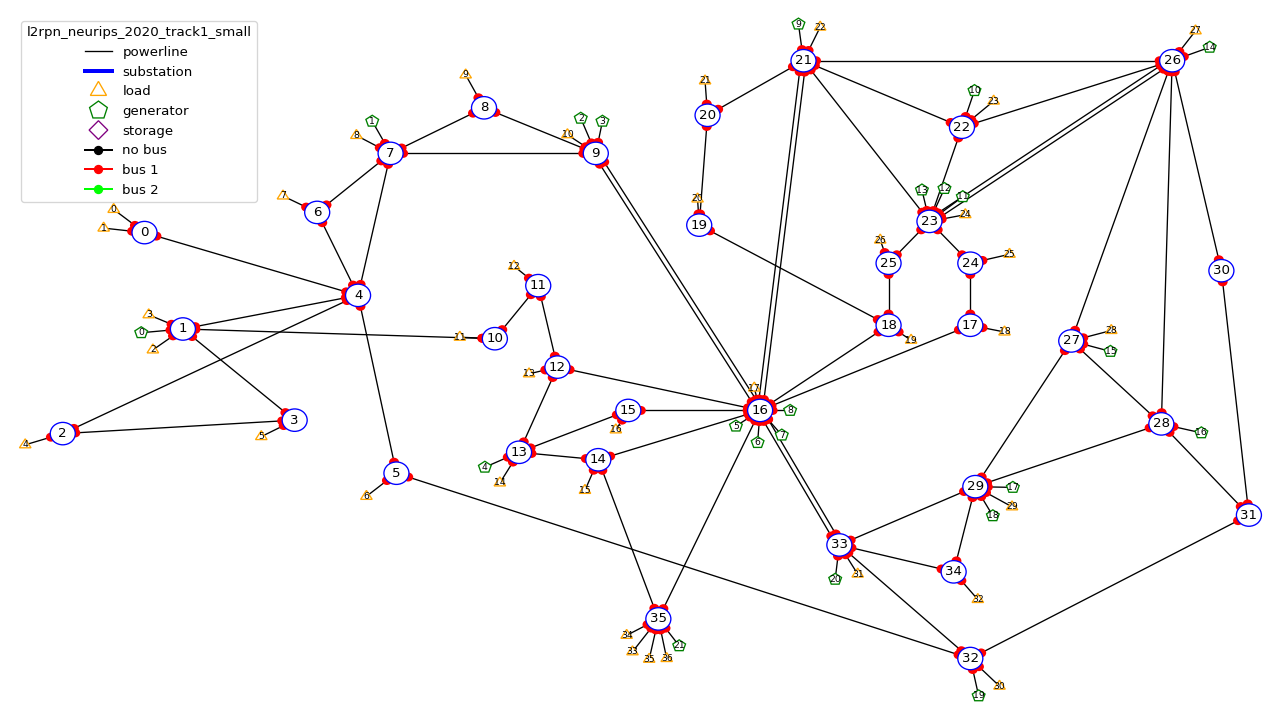
As example, you can look at the grid of the NeurIPS 2020 Challenge. Even though the graph is still quite comprehensible, the number of topology actions are here already around 70,000 actions. Thus, it is definitely important to only look at the most important ones.
Teacher Implementations
There are multiple implementations of this action space reduction in this project summarized in
teacher, which will be presented below.
All these implementations generate experience or collections of actions that are deemed useful by their reduction
of network overload(max rho). In the end the experience is used by the collect_teacher_experience module
to generate an action space for the Tutor.
Attacking Lines
The first teacher is contained in the teacher1 module.
It seeks to a random timestep in the environment, disconnects a line and tries to resolve the overflow by doing a greedy search over all unitary actions. It is similar to the N-1 search described below. When it finds an action that could lower the total load of the network it gets saved to a experience file.
Simple greedy search
The second teacher from teacher2 is much simpler than the first one.
It executes through the given environment and waits until an overload occurs. When that happens it does the same greedy search the upper does, saving any actions that could resolve the overflow and reducing the load of the network.
N-1 search
In order to collect actions that make the powernet more robust to future overloads a teacher was developed that tries to enforce n+1 redundany.
It is implemted in teacher_n_minus_1 with the main algorithm
being contained in the method n_minus_one_agent().
To do that it not only considers overloads but also actively tries to disconnect relevant lines during normal operation to then find actions that restore the network to a good state.
Tuple and triple search
In order to not only act on a single substation a teacher was implemented which tries to combine single/unitary
actions to tuple and triple actions. Those are implemented in the tuple_triple_teacher module.
They rely on previously generated actionspaces by the other unitary teachers and try to find new actions by randomly sampling other unitary actions of different substations. Note that this teacher is still experimental
Usage Example
All teachers can be run as a script or as a python function. The python function for the attacking teacher is called
run_attacking_teacher() for example produces an experience file, given an environment and further preferences.
The function can also be called as a script/cli, which is provided by defopt.
The following is a sample invocation of the teacher generating a file called exp_teacher1.csv:
python -m curriculumagent.teacher.teachers.teacher1 exp_teacher1.csv /home/paspartout/data_grid2op/l2rpn_neurips_2020_track1_small -j1
It equates to calling the python function similarly:
attacking_teacher(save_path=Path("exp_teacher1.csv"),
                  env_name_path="l2rpn_neurips_2020_track1_small", jobs=1)
The teacher processes will usually run indefinitely or when the number of specified episodes is reached.
After you have generated experience files with one or more teachers, you can use the functions
collect_teacher_experience.make_unitary_actionspace() or collect_teacher_experience.make_tuple_actionspace()
to convert those files to a reduced action space which can then be used by the Tutor.